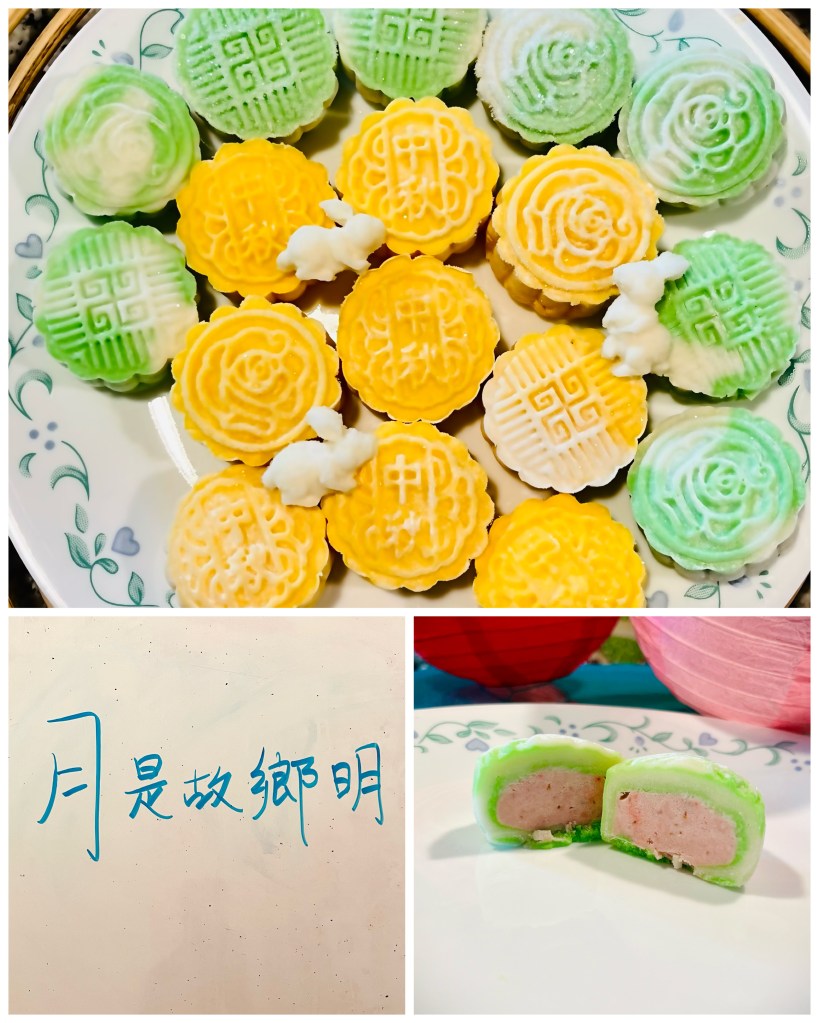
月是故鄉明
The moon is bright where the home is.
As the Chinese celebrate Mid-Autumn on this auspicious day, the above line from a beloved eighth-century poem is recited everywhere—in school, on YouTube, at home. Where is home? Sometimes I wonder.
My job as a language and math teacher comes with many pleasures. One of these pleasures is teaching children to write Chinese characters.
“I need to practice drawing these.”
“How do you draw that?”
Draw. Not write. Children are intuitive like that. After all, Chinese characters are pictographs. Take the character for moon, 月, for example. Does it not resemble the waxing crescent? It certainly does to children, and that’s why it is one of the easiest characters for them to learn. Draw, I mean.
Draw or write, I do my best to plant into those sprouting minds the very principle that every stroke is unique. Each stroke takes its shape through varying degrees of pressure from the wrist and fingers. Some strokes sweep forcefully from start to finish. Some flow from forceful to soft, while others swell from soft to forceful. Characters are thus born from the harmony of diverse strokes met in circular motions. Writing Chinese characters is practicing tai chi on paper: The writer must observe the interplay of soft and firm, vigor and calm, yin and yang.
From this perspective, writing in Chinese is therapeutic. It is therapeutic because it is exercise of ancient Chinese wisdom both physical and mental, an exercise of natural beauty. To write a character well, you need to make sure it is centered and symmetrical. You must appropriately apply the varying amount of force throughout each stroke, and just like Nature, no stroke is line perfectly straight. Natural balance and symmetry—that’s Beauty.
Another way to comprehend Chinese wisdom is through storytelling. Mid-Autumn is the day when the Chinese recall the story of the moon goddess Chang’e. The version I inherited goes like this: Chang’e was a beautiful young woman married to the legendary archer Hou-yi. When ten suns rose in the skies scorching the earth, destroying crops and livestock, Hou-yi with his bow and arrows shot down nine of the suns, leaving only one. To reward his heroic effort in saving all earthly lives, the Heavenly Queen Mother granted Hou-yi a draft of the Elixir of Immortality. One day, while her husband was away, Chang’e unwittingly found the elixir and drank it in its entirety. Immediately, the young woman ran from home and floated to the moon where she lived happily eternally with a jade rabbit as her faithful companion.
This is the origin of the Mid-Autumn Festival, the celebration of the harvest moon. A myth though archaic, it embodies an ethical and spiritual dimension edifying still to the modern mind. Throughout the ages, across many cultures, the sun is viewed as masculine; the moon, feminine. Hou-yi the husband shot down the suns; Chang’e the wife flew to the moon. According to a few traditions, Chang’e was punished for “stealing” her husband’s divine prize. Yet, the Chinese typically disregard this interpretation and focus instead on the young mortal’s apotheosis and, thereby, immortality. Although we recognize Hou-yi’s heroism, it is Chang’e whom we revere and immortalize. The key to longevity, Chinese wisdom teaches, is to live according to what Nature brings. Man may many a time attempt to be master over Nature, but the good life calls for a receptive nearness to Her. Such is the Chinese wisdom of the good life—the way of the Tao, the Nature’s Way.
In my lessons, I also make sure my students understand the two expressions of “moon” in the Chinese language. In Chinese, there is 月球, “lunar sphere,” and there is 月亮, “lunar radiance.” The former is used strictly as a scientific term, for example, in a sci-fi film or a lecture at a space center. The latter is the one used in everyday speech—lunar radiance—what poetic people the Chinese are! There’s a popular song all Chinese people would know—月亮代表我的心—“The lunar radiance is symbol of my heart.” With this, Debussy’s “Clair de Lune” springs to mind. In both musical works, the light of the moon points to something metaphysical, that is, something immanent—a light that dwells inside the heart. What is this light that makes the heart its home? In Debussy’s music, it’s your soul—the divine light of your soul—that’s the moonlight of the heart. Recall the beginning in the Book of Genesis when God created the world, and God says: Let there be light. Some biblical scholars interpret this primordial light to be the divine light of God—the light of divine wisdom—that precedes the physical creation of the heavenly stars and pervades all creation. The divine light isn’t a strong, blinding light, like that from the sun. It is soft. It is hidden. It nourishes the heart. Like the light of the harvest moon. To discover this light within one’s heart is to be in perfect reunion with the divine—that’s eternal life.
The moon is bright where the home is. But where is home? I sometimes wonder. Wisdom teaches that the moon shines where the home is, and home, perhaps, is where the heart shines.
Happy Mid-Autumn.
P.S. my very own strawberry cheesecake mochi moon cakes 🥮
 This Beautiful Moment