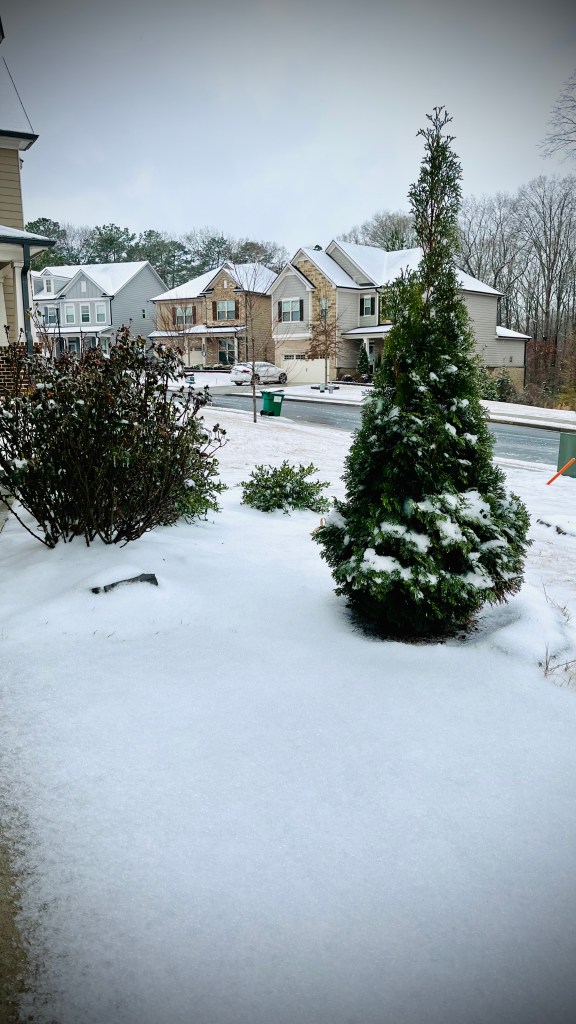
Snow in Georgia is a rare occurrence that brings life to a standstill. Not a soul wandering about. No traffic of any sort. It is Heaven’s mandate of restful solitude. Sure, messiness may soon follow when the snow melts. Work resumes. New deadlines to meet. But for now, I must rest and celebrate this Nature’s gift of serene restoration.
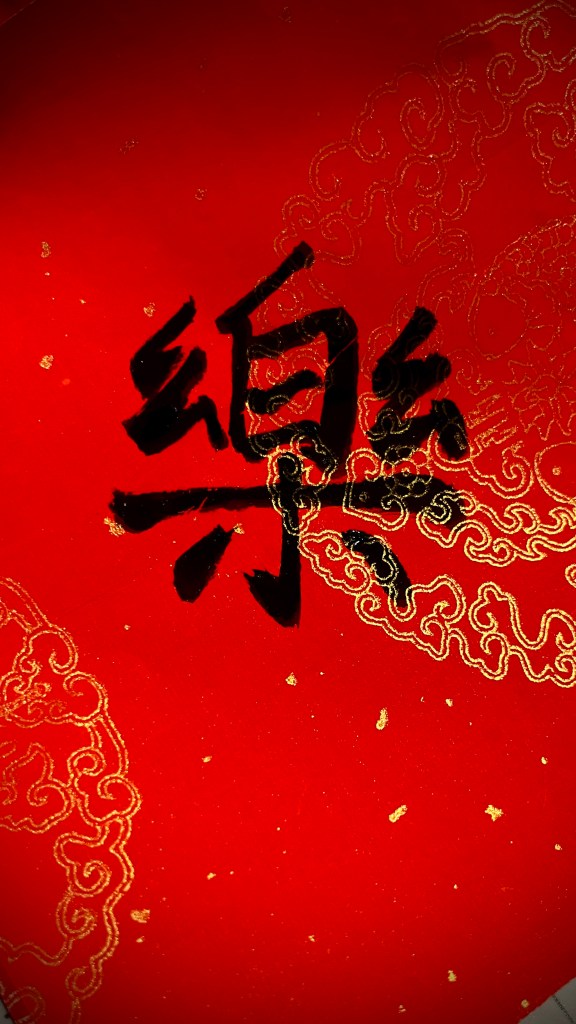
Well, 2025 has arrived. The Chinese ideogram that’s been on my mind throughout the day is 樂, the most general meaning of which is “happy”, as in 新年快樂, Happy New Year.
Furthermore, 樂 can be taken to mean joy, as in 喜樂. Or bliss, 極樂. Bliss. A word that leads me to think of the Pali and Sanskrit “Ananda”, or the Buddhist notion of eternal happiness and peace through enlightenment, as in 極樂世界, as well as joy of heaven in Christian theology, which is understood to be essential spiritual experience of God. Taken together, bliss appears to mean “union with the divine”.
Nonetheless, what strikes me most about the ideogram 樂 is its most original meaning: music, as in 音樂. The character in the most primitive oracle bone script was simply composed of two 糸 (strings) on top of 木 (wood). In other words, two strings on a piece of wood—a musical instrument. It was in the Spring and Autumn period that the character 白 “white, pure” was added between the two strings. So there, music is pure joy! I cannot agree more.
Following both eastern and western philosophies on bliss as divine union, for the new year, I need to focus on self-alignment. The past two years were extremely challenging for me physically and emotionally. Apart from persistent cancer, I was plagued by anxiety and depression. In this new year, more challenges will be confronting me. My care team and I are now in search for clinical trials around the country. Yet, above all, I must turn my attention inwardly. As I said goodbye to 2024, I have let go of some people for the sake of my journey toward healing. But one thing for sure is that I alone am ultimately responsible for my negative thoughts and feelings. I must return to 樂.
As an admirer of Stoicism, I “pray” for serenity to accept things that cannot be changed; courage to change things that must be changed; and the wisdom to distinguish one from the other.
On the day before yesterday, after my friend Carrie hopped into my car at the airport, our conversation immediately turned to the presidential election. On the one hand, we couldn’t wait for it to be over; on the other, we dreaded the outcome and the ensuing chaos. For the weekend, we resolved to help each other relax from election anxiety.
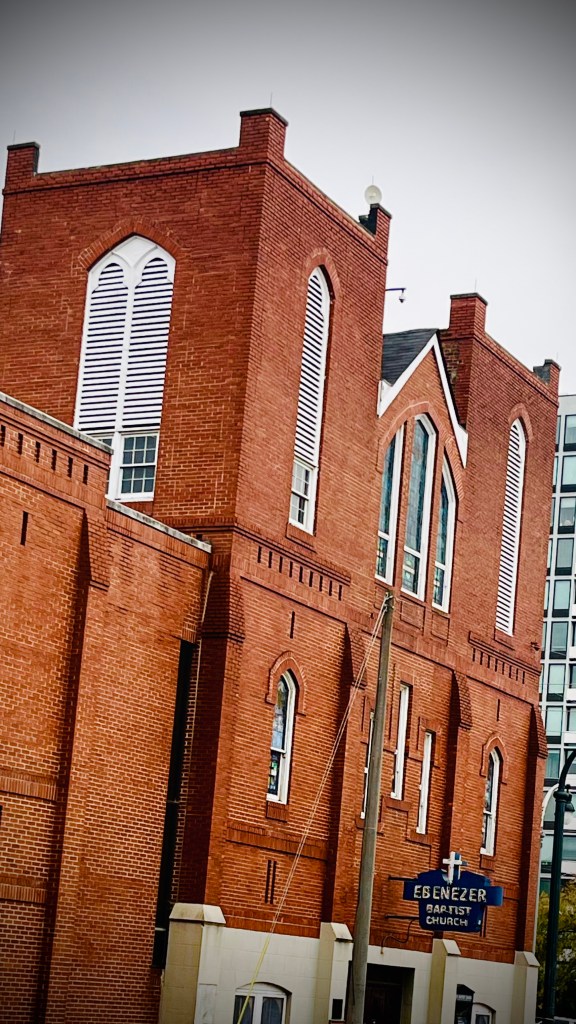
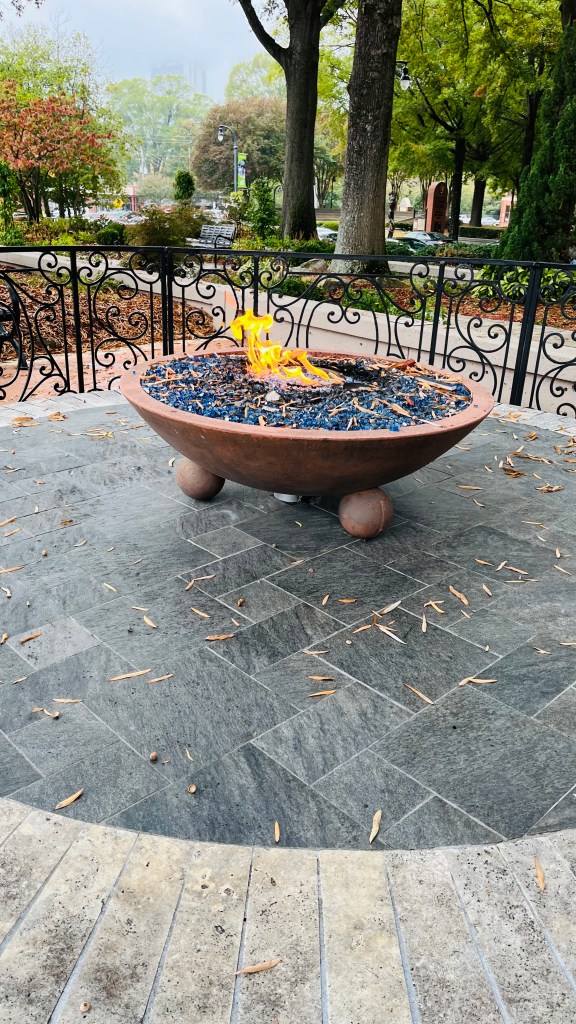
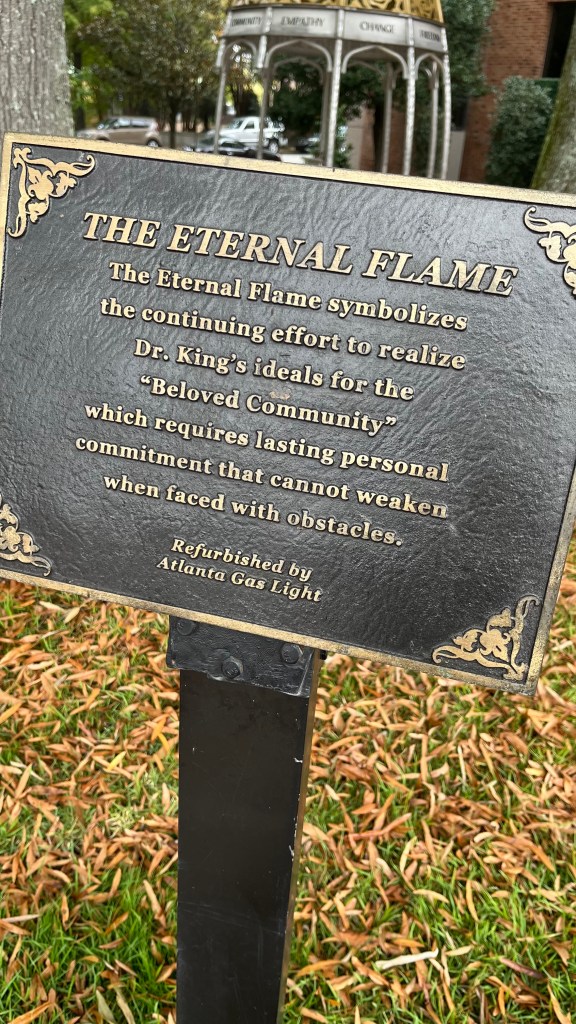
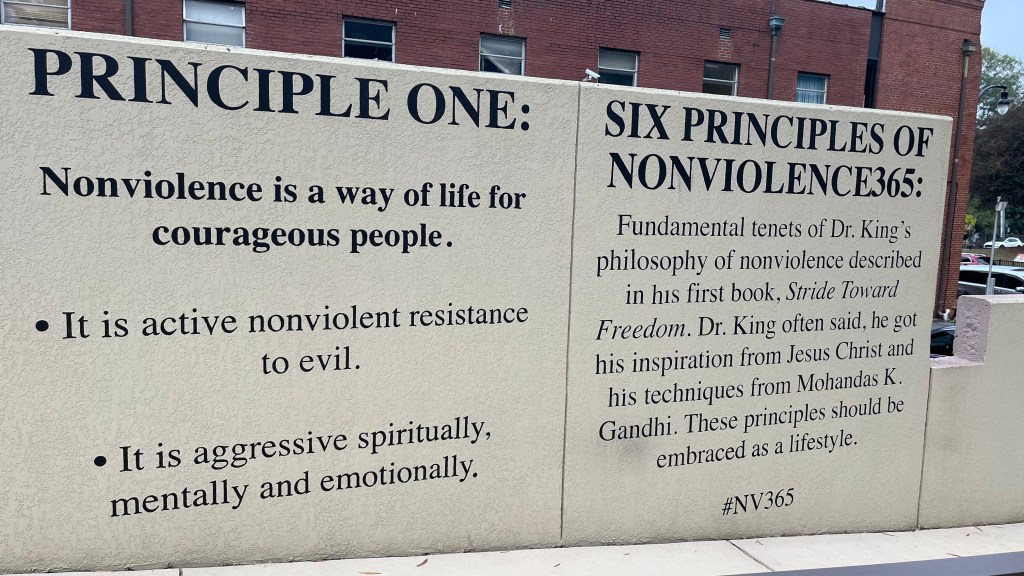
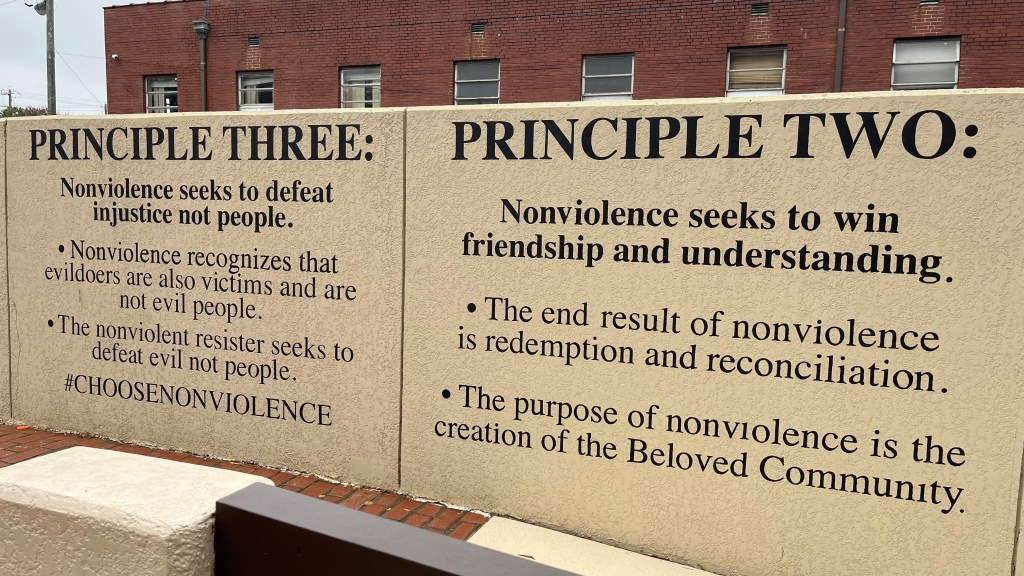
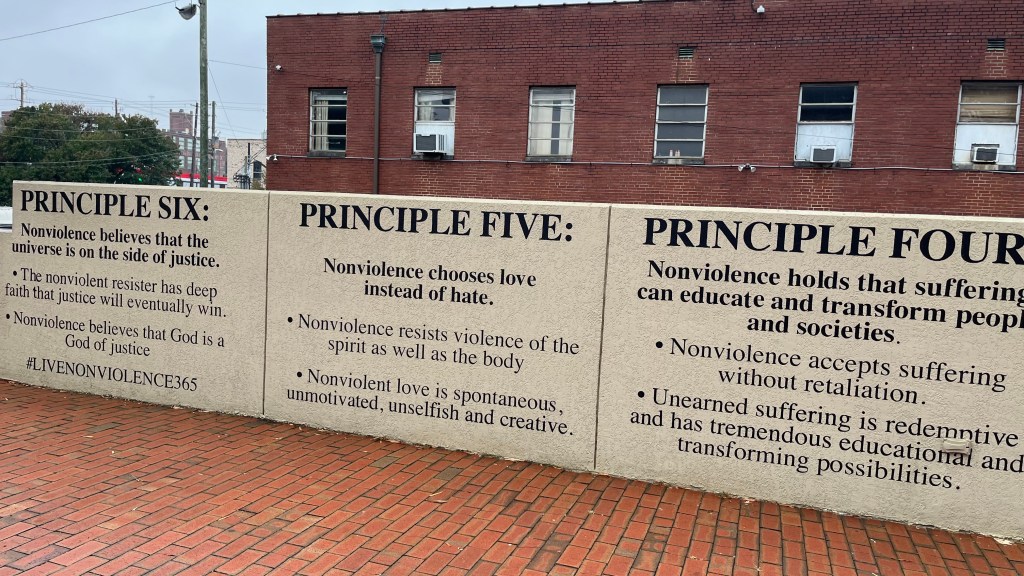
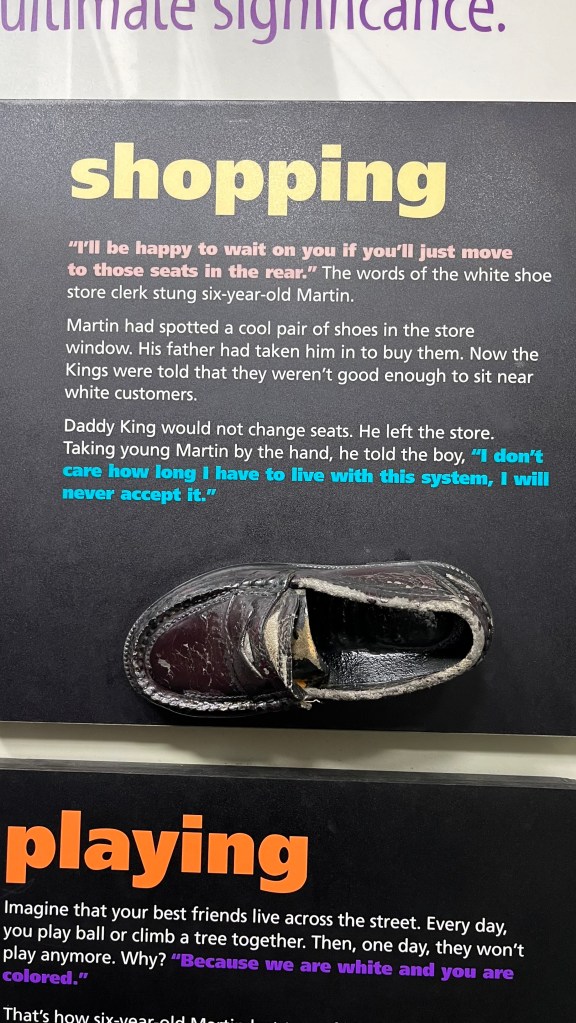
Thus our sleepy heads slowly woke to Sunday’s clouds and chills. After coffee at our cozy Parisian-style hotel, Spirit moved between us and within minutes, we were transported to the Martin Luther King National Historic Park. A lecture at the Ebenezer Baptist Church, Dr. King’s principles of nonviolence, his life and activism—what a soul-stirring, much-needed uplifting experience. My friend was so moved tears formed soft streams down her cheeks. A visit to this holy site often elicits deep emotions from the pilgrims.
It must sound cliched to say that Dr. King has had profound influence on me. Yet, it is a cliche that holds true even to this day. Often, I reminisce the times when I would listen to Dr. King’s sermons while jogging along the Stanford Dish trail. Those were precious moments of clarity intellectual and spiritual. The cadence of his voice, the poetry of his words, the prophetic power of his truth, captivated me like ritual incantations of an ancient seer. At the National Park, I was reminded yet again that to live is an act of courage, and to have courage is an act of faith.
Not only Dr. King but Mrs. King’s words convey enormous power in equal measure: “Women, if the soul of the nation is to be saved, I believe that you must become its soul.” What we experience as a nation today is a collective sickness of a spiritual kind. The struggle for women’s rights remains as relevant as it was 50 years ago.
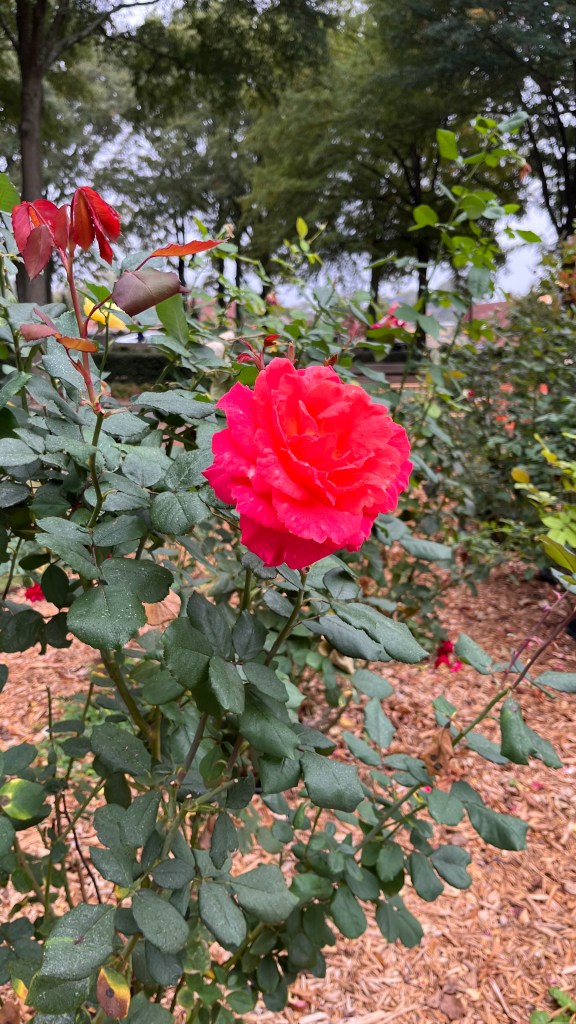
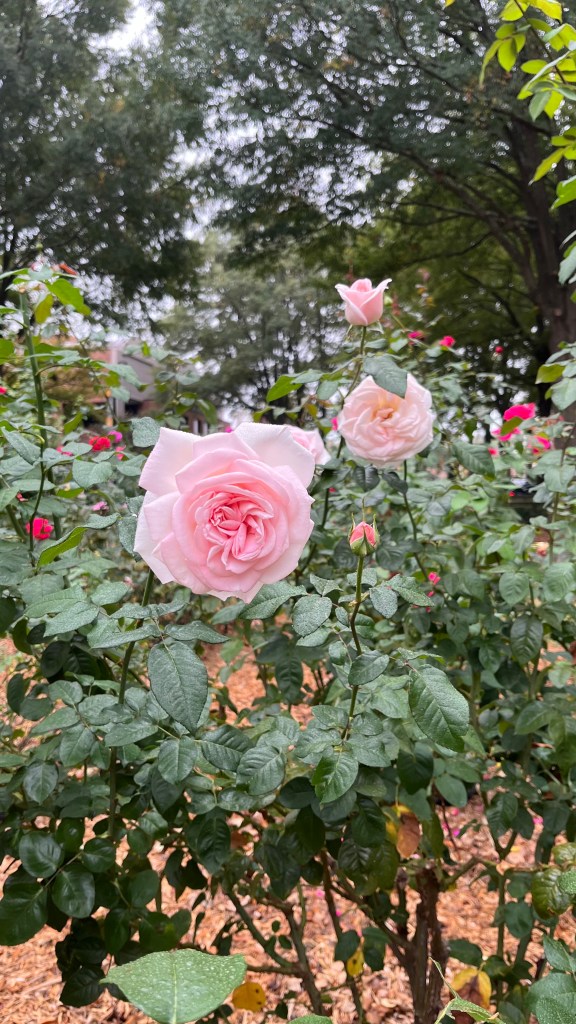
The historic site was pregnant with prophetic murmurs of human strength and hope. The misty air heightened its sacredness. Yesterday, Sweet Auburn smelled of sweet autumn rose.
Two days ago was yours truly’s birthday. But the day also marked the first anniversary of the Israel-Hamas War. In one year alone, nearly 42,000 lives have been lost in Gaza; 1,700 in Israel; 620 in the West Bank; 530 in Lebanon.
Fauré’s Pie Jesu.
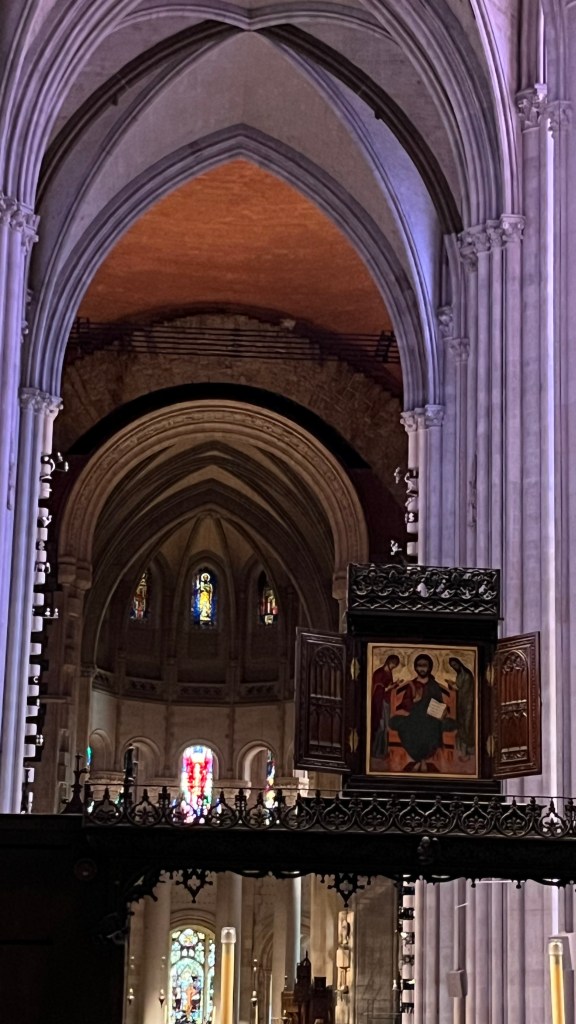
So that afternoon I remained in my beloved sanctuary—the Cathedral Church of St. John the Divine—just as I did on the 30th of December in the year 2012. In those days, my heavy heart was laden with melancholy. I sat humbly in a pew, thinking of the people of Syria, and of the families of Sandy Hook. Prayers to a deity never channeled solace to this iconoclast. That function rested with music, and always will. Slowly, silently, a song emerged in my mind.
In the spirit of Fauré’s Pie Jesu (my favorite rendition posted in the comment section below), I’d like to bring you a prayer of sorts that have gently gathered in my mind over the few days past:
Pie Jesu is the centerpiece of Gabriel Fauré’s monumental Requiem (Mass for the Dead). Never known to be a religious man, Fauré composed his Mass with his signature mélange of melodic elegance, harmonic complexity, and deceptive airs of simplicity, masterfully expressing the richness of a spirituality only true artists can cultivate. What strikes me most is that this Requiem, unlike typical Requiems, has the entire movement of Dies Irae (Day of Wrath) omitted, replacing it with Pie Jesu (Merciful Jesus). As an artist and agnostic, Fauré must have favored mercy vastly more than judgment, preferring restful consolation infinitely to eternal hellfire. The words of the maestro himself sum up most aptly: “Everything I managed to entertain by way of religious illusion I put into my Requiem, which moreover is dominated from beginning to end by a very human feeling of faith in eternal rest.”
In the spirit of Fauré’s Pie Jesu, I’d like to bring you a prayer of sorts that have gently gathered in my mind over the few days past:
May the world be filled with
less condemnation,
more merciful helping hands;
less fisted praise of brutality,
more tears of empathy;
less hurtful haste,
more sweet repose;
less platitude of sermon,
more wakeful hours in serene silence.
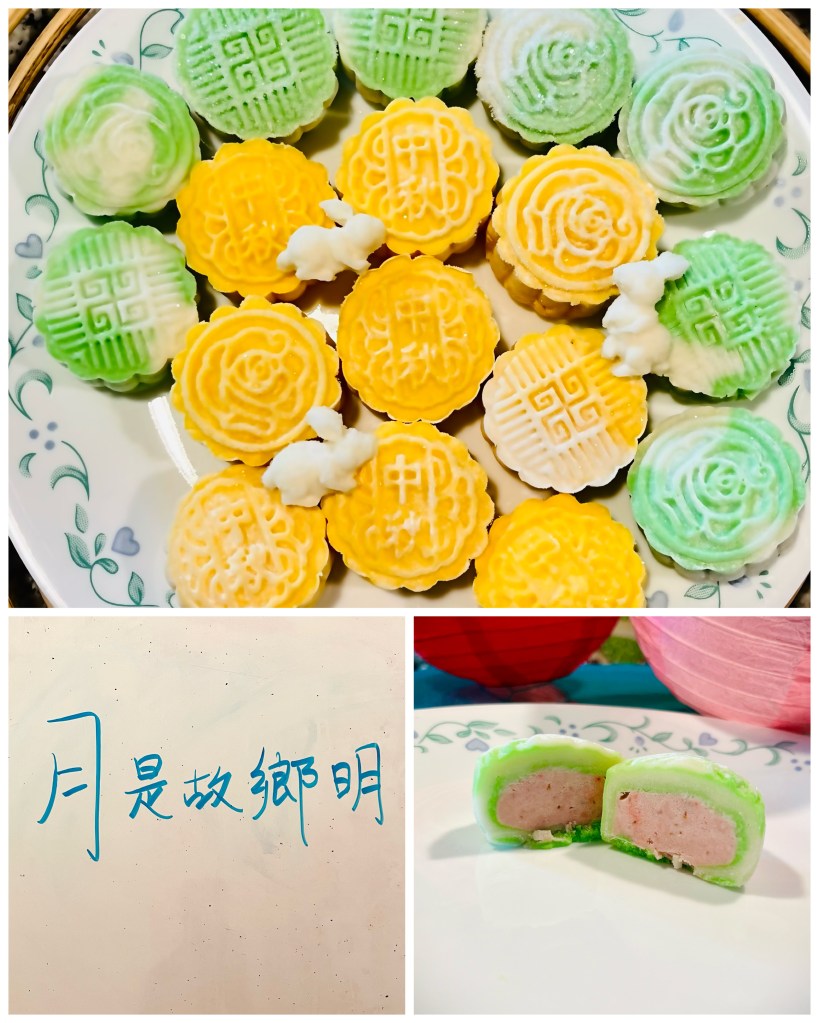
As the Chinese celebrate Mid-Autumn on this auspicious day, the above line from a beloved eighth-century poem is recited everywhere—in school, on YouTube, at home. Where is home? Sometimes I wonder.
My job as a language and math teacher comes with many pleasures. One of these pleasures is teaching children to write Chinese characters.
“I need to practice drawing these.”
“How do you draw that?”
Draw. Not write. Children are intuitive like that. After all, Chinese characters are pictographs. Take the character for moon, 月, for example. Does it not resemble the waxing crescent? It certainly does to children, and that’s why it is one of the easiest characters for them to learn. Draw, I mean.
Draw or write, I do my best to plant into those sprouting minds the very principle that every stroke is unique. Each stroke takes its shape through varying degrees of pressure from the wrist and fingers. Some strokes sweep forcefully from start to finish. Some flow from forceful to soft, while others swell from soft to forceful. Characters are thus born from the harmony of diverse strokes met in circular motions. Writing Chinese characters is practicing tai chi on paper: The writer must observe the interplay of soft and firm, vigor and calm, yin and yang.
From this perspective, writing in Chinese is therapeutic. It is therapeutic because it is exercise of ancient Chinese wisdom both physical and mental, an exercise of natural beauty. To write a character well, you need to make sure it is centered and symmetrical. You must appropriately apply the varying amount of force throughout each stroke, and just like Nature, no stroke is line perfectly straight. Natural balance and symmetry—that’s Beauty.
Another way to comprehend Chinese wisdom is through storytelling. Mid-Autumn is the day when the Chinese recall the story of the moon goddess Chang’e. The version I inherited goes like this: Chang’e was a beautiful young woman married to the legendary archer Hou-yi. When ten suns rose in the skies scorching the earth, destroying crops and livestock, Hou-yi with his bow and arrows shot down nine of the suns, leaving only one. To reward his heroic effort in saving all earthly lives, the Heavenly Queen Mother granted Hou-yi a draft of the Elixir of Immortality. One day, while her husband was away, Chang’e unwittingly found the elixir and drank it in its entirety. Immediately, the young woman ran from home and floated to the moon where she lived happily eternally with a jade rabbit as her faithful companion.
This is the origin of the Mid-Autumn Festival, the celebration of the harvest moon. A myth though archaic, it embodies an ethical and spiritual dimension edifying still to the modern mind. Throughout the ages, across many cultures, the sun is viewed as masculine; the moon, feminine. Hou-yi the husband shot down the suns; Chang’e the wife flew to the moon. According to a few traditions, Chang’e was punished for “stealing” her husband’s divine prize. Yet, the Chinese typically disregard this interpretation and focus instead on the young mortal’s apotheosis and, thereby, immortality. Although we recognize Hou-yi’s heroism, it is Chang’e whom we revere and immortalize. The key to longevity, Chinese wisdom teaches, is to live according to what Nature brings. Man may many a time attempt to be master over Nature, but the good life calls for a receptive nearness to Her. Such is the Chinese wisdom of the good life—the way of the Tao, the Nature’s Way.
In my lessons, I also make sure my students understand the two expressions of “moon” in the Chinese language. In Chinese, there is 月球, “lunar sphere,” and there is 月亮, “lunar radiance.” The former is used strictly as a scientific term, for example, in a sci-fi film or a lecture at a space center. The latter is the one used in everyday speech—lunar radiance—what poetic people the Chinese are! There’s a popular song all Chinese people would know—月亮代表我的心—“The lunar radiance is symbol of my heart.” With this, Debussy’s “Clair de Lune” springs to mind. In both musical works, the light of the moon points to something metaphysical, that is, something immanent—a light that dwells inside the heart. What is this light that makes the heart its home? In Debussy’s music, it’s your soul—the divine light of your soul—that’s the moonlight of the heart. Recall the beginning in the Book of Genesis when God created the world, and God says: Let there be light. Some biblical scholars interpret this primordial light to be the divine light of God—the light of divine wisdom—that precedes the physical creation of the heavenly stars and pervades all creation. The divine light isn’t a strong, blinding light, like that from the sun. It is soft. It is hidden. It nourishes the heart. Like the light of the harvest moon. To discover this light within one’s heart is to be in perfect reunion with the divine—that’s eternal life.
The moon is bright where the home is. But where is home? I sometimes wonder. Wisdom teaches that the moon shines where the home is, and home, perhaps, is where the heart shines.
Happy Mid-Autumn.
P.S. my very own strawberry cheesecake mochi moon cakes 🥮




 This Beautiful Moment